Scaling a B2B SaaS product is anything but a linear ride. There comes a time when you hit a wall. The product is ready but the story isn’t. Or the story exists but nobody owns making it consistent across the org. Or the team is shipping fast but the customers are the last to know.
I help B2B SaaS companies and founders cross this gap. As a hands-on product marketer who has personally filled this role multiple times, here is how I operate.
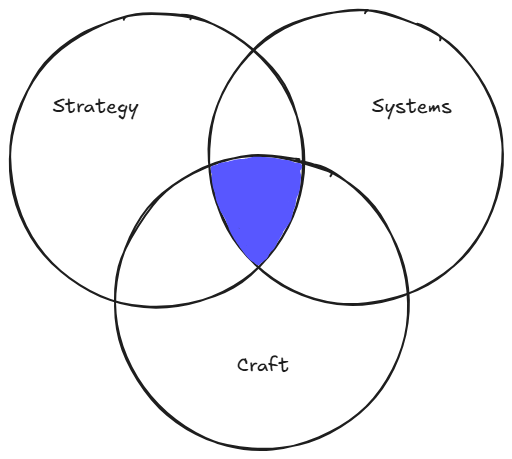
Strategy
What’s the no. 1 metric for product-led growth? Conversion. Visitor to trial. Trial to paid. Paid to repeat. And so on.
Conversion can only occur when the message resonates with the prospect or customer. To create such a message, I need a deeper understanding of the buyer. But, real understanding can only come from real conversations.
To build empathy with the customers, I prioritize deep interactions to generate buyer insights. Whether it’s conducting interviews to research demand for a new product, figuring out usage patterns, or asking churned users why they left.
These insights form the basis of my messaging framework. This is why I thrive in teams that enable me to go meta, building such insights first. To do this, I have donned the hats of a customer success agent, a sales lead, and an account manager, not limiting myself to a marketer.
Customer-first in practice. Not just in theory. I align with founders and builders who practice this strategy.
Craft
Craft is caring enough to get the details right.
What got me into product marketing was using creative thinking to solve go-to-market problems. Over time it became my calling. And the longer I did it, the more I realized that the work that actually moves people is specific, human and authentic. It doesn’t feel like the polished slop that we encounter these days.
Anyone can write now with LLM’s help. That’s a problem and an opportunity. When everything is generated at speed, authenticity becomes the differentiator. The copy that lands sounds like a real person who understands the reader’s situation, not a summary of their product page.
Moreover, I see AI as a powerful tool. It helps me work faster and avoid errors but it doesn’t decide what good looks like. That part stays mine.
This approach is grounded in principles I’ve built over a decade of doing this work. I’ve written more about it here.
Systems
Craft without process doesn’t scale.
By system I mean, people and tools aligned around a clear process, with shared expectations on what gets produced. The goal is to enable teams and individuals to run without reinventing anything.
A video creation workflow that ties together script generation, voiceover, product screenshots, and reuse across channels. A product launch process that pulls from feature specs and meeting transcripts to extract customer benefits, drafts content using a template, runs A/B tests on copy, and feeds results back into the next launch.
These workflows compound in value the more you run them and makes it easy to tweak a single element without disrupting everything else.
These systems are never finished. Every breakdown in the GTM process is an input to consider. Whether it was a wrong message sent to customers, a campaign that didn’t land, or a sales team that ignored the battlecard. Each one tells you where the process has a gap that needs fixing.
This is where an experienced PMM earns their place. Someone has to see the whole board, not just a single piece. The system only stays healthy if someone owns it end to end.
I’ve done this work across different stages and scale: zero to first users, first users to category leader, and solidifying existing position. If your messaging isn’t converting, your launches feel inconsistent, or your sales team is winging it in demos, those are solvable problems.
Get in touch if you would like to solve your go-to-market problems. Book a free discovery call.